How Bonfire CRM turns scattered sales context into account intelligence.
Bonfire CRM is a SaaS-ready, AI-native CRM and Ready-to-deploy Technology Asset built by Lucents Technology for sales teams that sell through relationships, long conversations, and details that cannot get lost.

Bonfire Agent
Accounts, contacts, pipeline, account knowledge, and Bonfire Agent in one interface
5 core modules unified in one product: Home, Accounts, Contacts, AI Pipeline, and Bonfire Agent
1 dedicated knowledge base for every account
2 pipeline views shipped: searchable table and funnel board
1 AI agent embedded into daily sales workflows
1 Ready-to-deploy Technology Asset that can be adapted to each client's sales process
The Context
Sales teams had the data. They did not have the memory.

Most CRMs are good at holding records. They can store contacts, track opportunities, and show a pipeline stage. But the real work of selling rarely lives inside a neat field.
It lives in meeting notes, email threads, proposals, product documents, contracts, past objections, follow-up promises, and the small details a rep remembers before a call. When that context stays spread across different tools, the CRM becomes a place teams update after the work happens. Not the place that helps them do the work.
That was the opening for Bonfire CRM.
Lucents wanted to build a CRM where each account carries its own working memory. Not a generic AI box sitting beside the product. Not a chatbot that only answers broad questions. A system where the AI reads the same account materials the sales team depends on, then helps with pipeline review, follow-up, deal risk, meeting prep, and next-step decisions.
The product had to stay focused. Accounts, contacts, opportunities, account knowledge, and an AI agent. Enough structure to run a real sales motion. Enough intelligence to remove the parts that usually slow teams down.
Industry Pain Point
The sales industry has a memory problem.

Sales teams do not lose deals only because they lack leads. They lose momentum because context breaks at every handoff.
A salesperson may speak with a lead on LinkedIn, continue the conversation by email, store files in Drive, discuss next steps on WhatsApp, log activity in a CRM, and keep the most important nuance in their own head. By the time the next call happens, the rep is forced to rebuild the story from scattered fragments.
That creates the same pattern across sales organizations:
- Reps spend too much time searching before they can sell
- Managers review pipelines without the full story behind each deal
- New team members inherit records but not relationship context
- Follow-ups depend on memory instead of system support
- Valuable conversations disappear when people change roles or leave the company
This is not only a platform problem. It is an industry problem for teams that sell through trust, timing, and long conversations. The modern sales person is expected to remember every customer detail, every objection, every promise, and every next step while working across tools that were never designed to think together.
Bonfire CRM was built to change that. It turns account history, documents, activities, and pipeline movement into a working memory that every sales team can use.
How Lucents Forward Deploys the Solution
Lucents brings the asset, then deploys it into the client's sales reality.
Lucents does not approach Bonfire CRM as a one-off custom build. Bonfire CRM is a Ready-to-deploy Technology Asset. The core product already exists, with structured CRM modules, account knowledge bases, and Bonfire Agent.
The difference is how Lucents deploys it.
Instead of handing clients a generic platform and asking their sales team to change overnight, Lucents forward deploys the Ready-to-deploy Technology Asset into the client's actual sales motion. The product is configured around the way their team manages leads, reviews opportunities, stores documents, prepares for meetings, and follows up.
Lucents' forward deployment process focuses on five moves:
- 1Map the real sales workflow: how leads come in, how deals move, where context lives, and what slows reps down.
- 2Configure the CRM foundation: accounts, contacts, opportunities, pipeline stages, roles, and daily views.
- 3Build account-level knowledge: organize the documents, notes, and materials that Bonfire Agent needs to reason from.
- 4Embed the agent into the workflow: place Bonfire Agent where reps already make decisions, including the home screen and AI Pipeline sidebar.
- 5Train, observe, and refine: work with the client team after deployment to improve the product around real usage.
This is what separates Lucents from a standard technology vendor. Lucents brings a Ready-to-deploy Technology Asset, a product team, and a forward deployment motion. Clients do not start from a blank page. They start from a working CRM asset, then get the depth of customization needed for their sales team to actually use it.

Case Study
Forward deployed for a global sales partner in Sweden.
Lucents deployed Bonfire CRM with a global sales partner in Sweden to support relationship-led sales work across lead management, opportunity tracking, and follow-up planning.
The partner needed one place to manage active leads, explore new opportunities, track sales conversations, and keep context available before each interaction. Bonfire CRM gave the team a SaaS-style workspace where leads, accounts, contacts, documents, and AI-assisted next steps could live together.
The deployment helped the partner simplify the daily sales process:
- Manage leads and account records in one place
- Explore new opportunities with clearer pipeline visibility
- Prepare for calls with account-level context
- Use Bonfire Agent to remember past conversations and suggest next actions
"Bonfire CRM looks very promising. It automates the repetitive parts of my work, helps me remember every customer context, and gives me a clearer way to manage and follow up with leads. I can see other sales teams benefiting from this too."
The Approach
One CRM, built around account-level context.
Bonfire CRM was designed as a Ready-to-deploy Technology Asset from day one. The goal was not to build a static internal tool. The goal was to create a reusable, SaaS-ready CRM foundation that Lucents could forward deploy for different sales teams without rebuilding the product each time.
Phase 01: Define the relationship model
Lucents started with the core sales objects: accounts, contacts, opportunities, campaigns, activity history, and documents. The product needed a clean structure before the AI layer could be useful.
Each account became the center of the system. Contacts connect to accounts. Opportunities connect to accounts and contacts. Documents connect back to the account they belong to.
This gave Bonfire CRM a simple rule: every piece of knowledge should have a home.
Phase 02: Build the working CRM
The first product layer covered the daily workflow. Teams can manage accounts, add contacts, track deal values, update stages, search opportunities, and switch between table and funnel views.
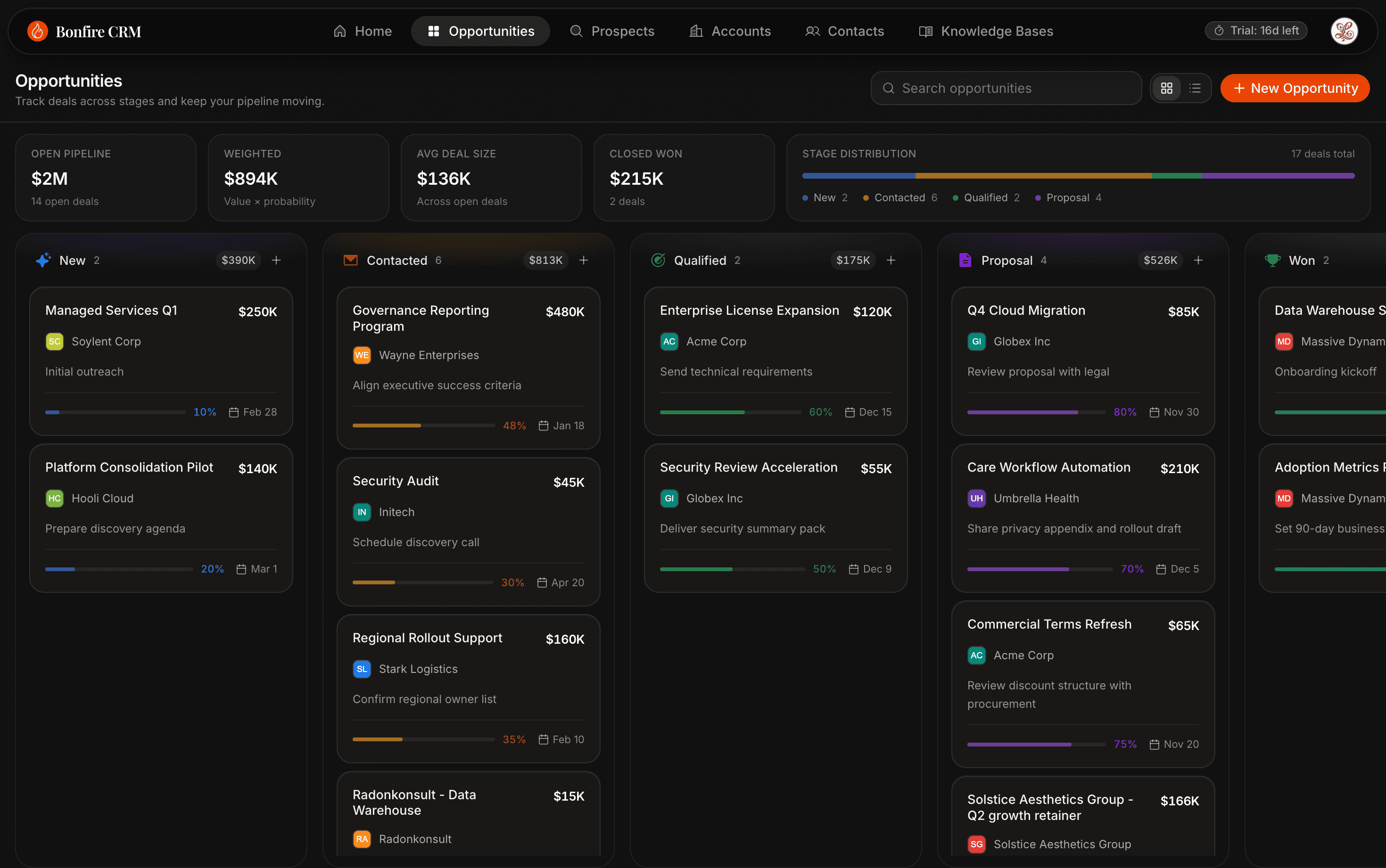
The pipeline was designed for two working modes. Table view gives users a clean operating list. Funnel view gives them the board they need when reviewing movement across stages.
Bonfire Agent can also open as a sidebar inside the pipeline, so the user does not have to leave the deal view to ask for a summary, draft outreach, or check what should happen next.
Phase 03: Add account knowledge as the AI foundation
The knowledge base is where Bonfire CRM separates itself from a standard CRM.
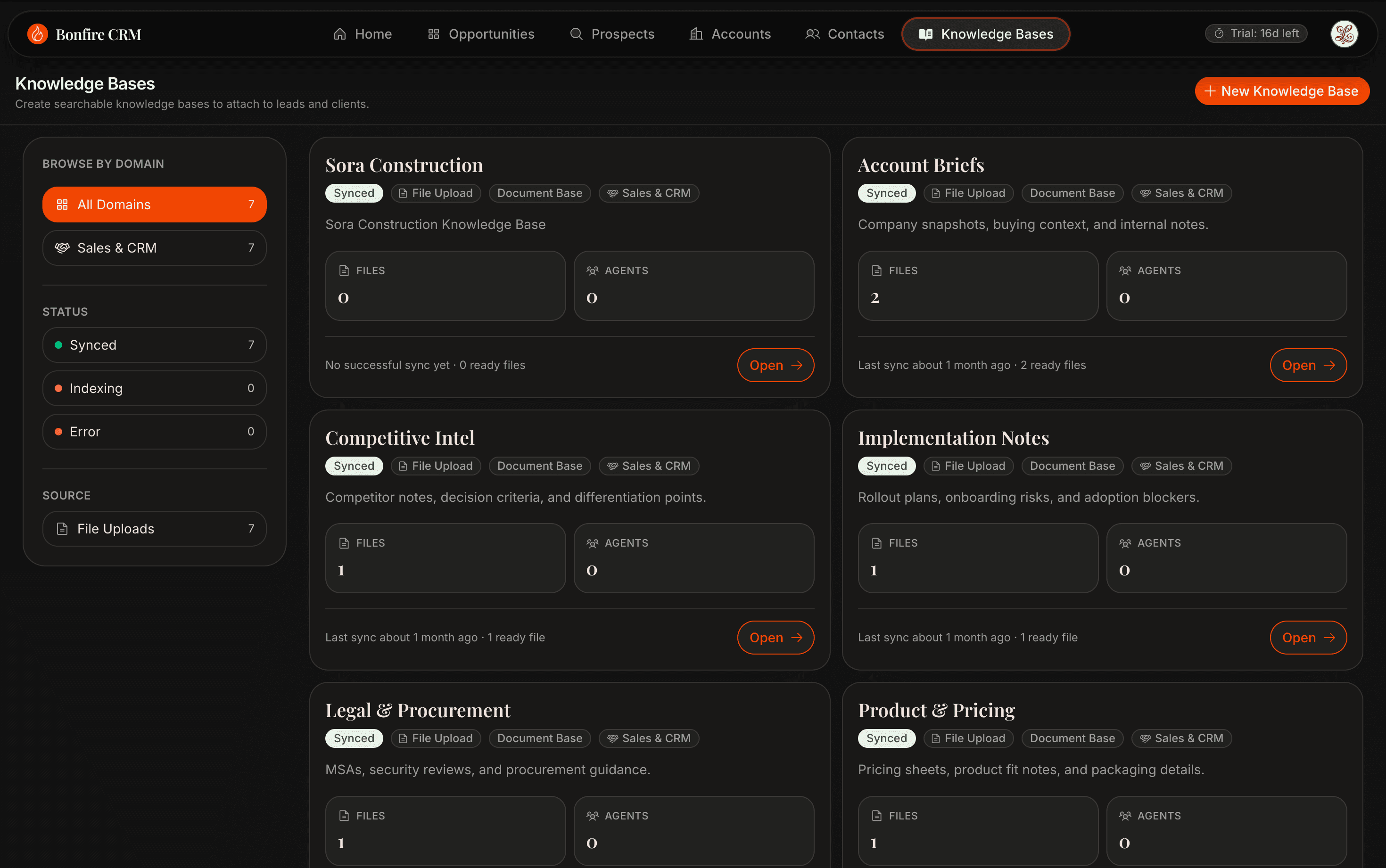
Every account has its own dedicated document base. Teams can upload service guides, proposals, product documents, contracts, notes, and sales material. Files are organized by domain and tracked by sync status, including Synced, Indexing, and Error.
This keeps the AI grounded in the account being worked. The agent is not guessing from a loose database. It is working from scoped context tied to the relationship.
Phase 04: Put the agent at the start of the day
The home screen opens with Bonfire Agent. A user can start by asking what changed in the pipeline, which deals need attention, what to send after a call, or how to prepare for a meeting.
The agent is also built around suggested actions, so common sales tasks are one step away:
- Summarize today's pipeline status
- Identify opportunities most likely to close next
- Draft outreach for a new opportunity
- Suggest next steps for this week's follow-ups
Deliverables
What Lucents built for Bonfire CRM
AI-powered CRM experience
A clean platform experience built for daily sales work. Bonfire CRM gives users one interface for accounts, contacts, opportunities, knowledge, and agent-assisted action.
- Modular product architecture
- Web-based CRM workspace
- Configurable workflows for client deployment
- Ready-to-deploy Technology Asset foundation
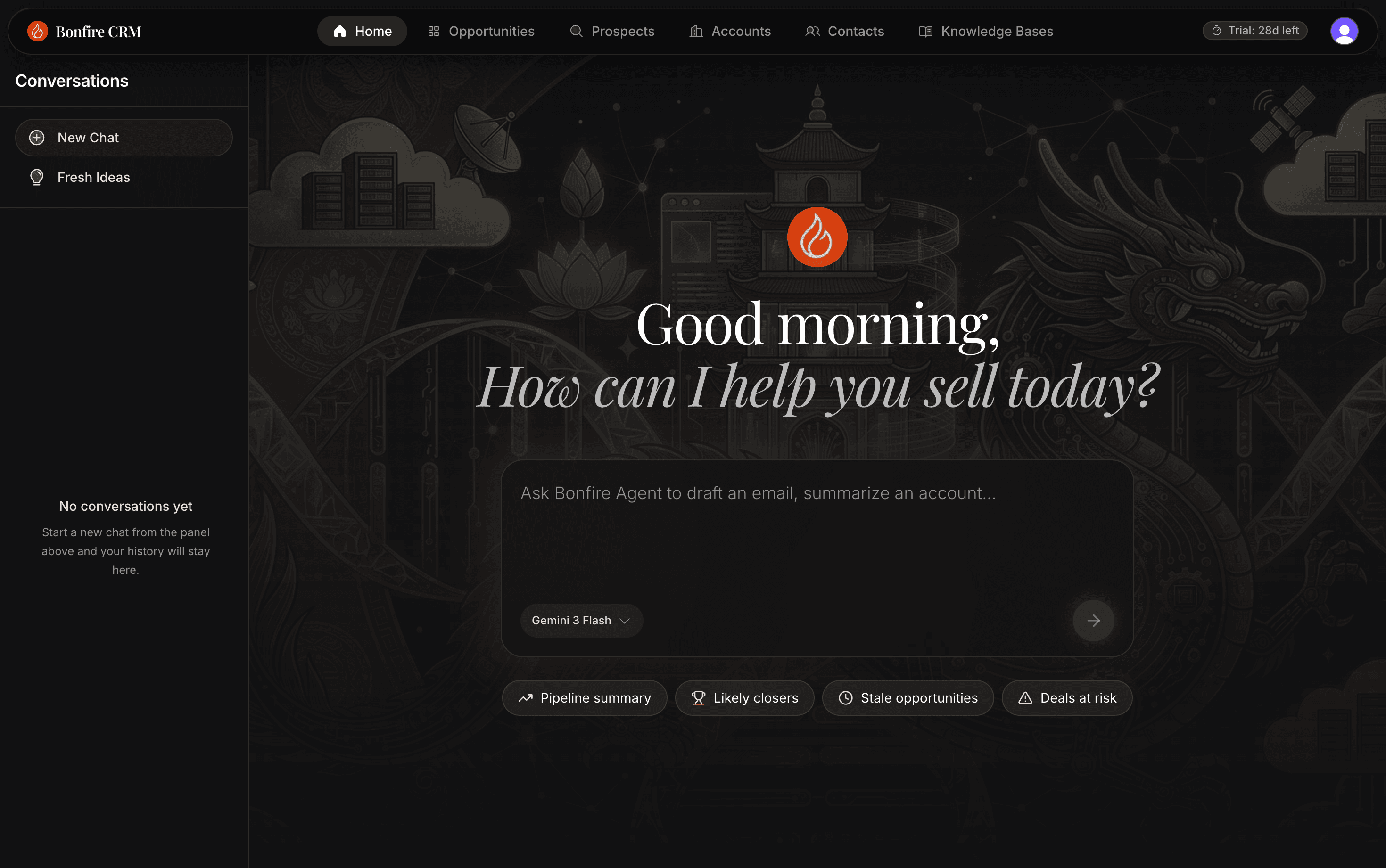
Home and Bonfire Agent
A daily starting point built around a prompt box. Users can ask for pipeline summaries, outreach drafts, follow-up plans, or deal recommendations without digging through records first.
- Agent-first home screen
- Suggested action cards
- Configurable AI model selection
Account Management
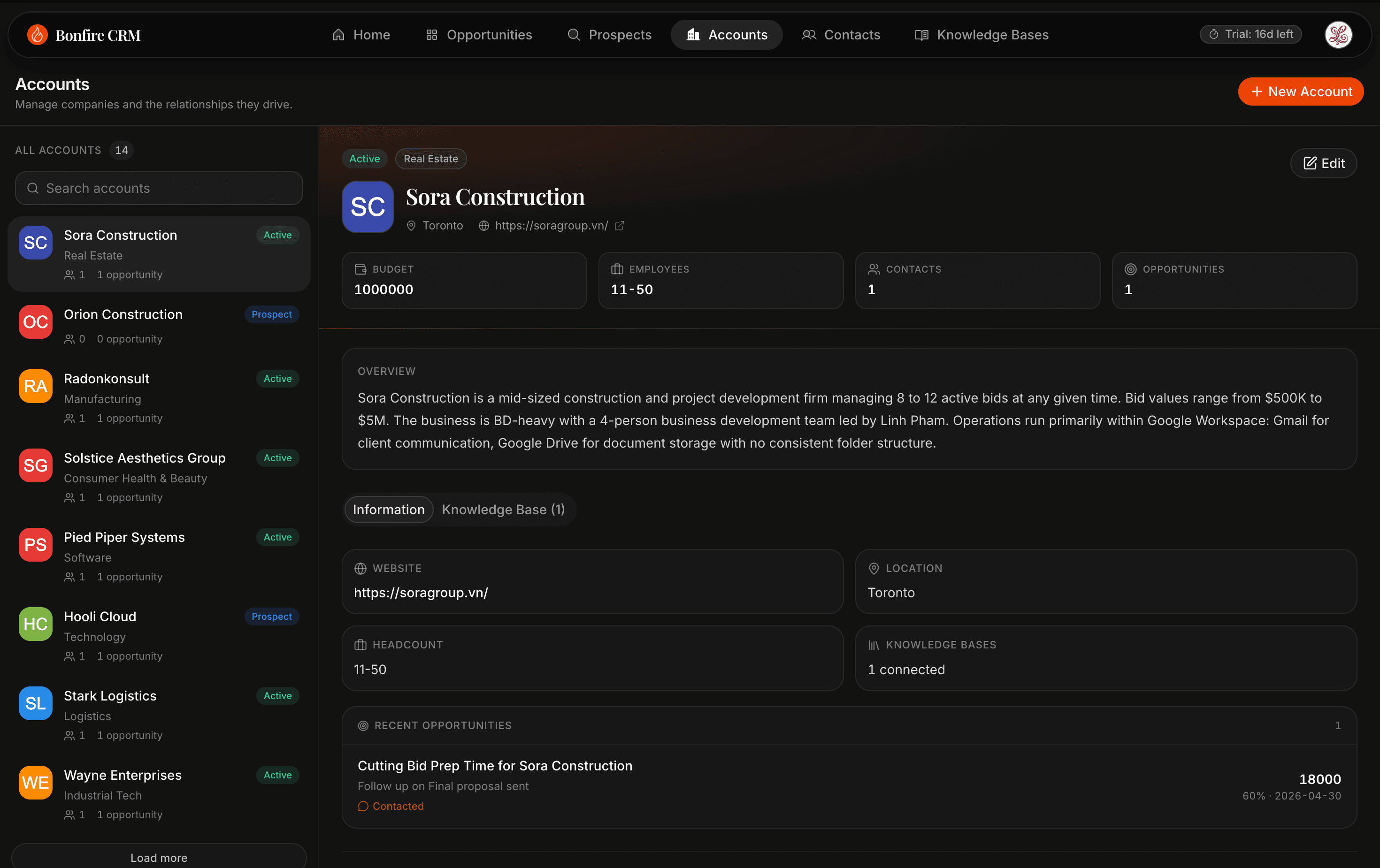
A structured account workspace for company-level records. Each account includes profile details, deal value, point of contact, active campaigns, activity history, and its own knowledge base tab.
- Add, edit, and delete accounts
- Account information and knowledge base tabs
- Activity history tied to the company record
Account Knowledge Base
A dedicated knowledge layer for every account. Sales teams can upload and index the documents that matter for a relationship, then use that material as context for AI-assisted work.
- Account-specific document storage
- Domain-based file organization
- Sync status tracking for uploaded files
AI Pipeline
An opportunity management workspace with table and funnel views. Reps can search, filter, update stages, review deal values, and see last activity without switching tools.
- Searchable opportunity table
- Kanban-style funnel board
- Pipeline cards with account, contact, deal value, campaign, and last activity
Build a CRM that remembers the relationship.
Bonfire CRM gives sales teams one place for accounts, contacts, opportunities, documents, and AI-assisted action. It is a Ready-to-deploy Technology Asset that Lucents can forward deploy into real sales teams, then shape around how they work.
Less searching. Fewer forgotten details. More useful context before every conversation.
Book a demo.