
How Vo & Associates moved from manual legal operations to an AI-powered operating system for the firm.
One platform for cases, documents, clients, finance, support, and AI drafting. Built around how legal work actually moves across lawyers, paralegals, and clients.

AI-powered legal collaboration platform
Cases, Clients, Vault, AI Agent, Support Requests, Finance
2 connected dashboards for the firm team and clients
3 user roles with scoped access: Admin, Team Member, Client
6 core work areas: Cases, Clients, Vault, AI Agent, Support Requests, Finance
4 AI work modes for drafting, review, research, and case review
1 document vault for general law, internal materials, and case documents
The context
Legal work was moving faster than the systems around it.

Vo & Associates needed a better way to run legal matters across lawyers, paralegals, and clients.
Each matter had its own documents, deadlines, internal notes, client questions, follow-up work, revenue context, and review cycles. The firm also needed Vietnamese and English workflows to live close together, because bilingual legal work could not be treated as an afterthought.
The first instinct in the market is often to add a chatbot. That was not enough here.
Legal AI only works when the surrounding system is clean. Documents must belong to the right case. Internal notes must stay internal. Client-visible work must be separated from firm-only work. AI-generated drafts must be reviewed before they become client documents. Client questions need grounded answers, and some questions still need a human lawyer.
Vo&AI Law started from that reality. The product was designed as the operating layer around legal work, with AI placed inside the workflow where it could save time without breaking trust.
Industry pain point
Legal firms still run too much of the business by hand.

The problem was not unique to Vo & Associates. Across the legal industry, many firms still operate through email threads, folder structures, chat messages, spreadsheets, and personal memory.
That creates daily friction.
A lawyer needs the latest version of a contract, but it may be buried in a chat thread. A paralegal needs to know which task is urgent, but the context sits in someone's inbox. A client asks for an update, but the answer requires checking documents, notes, timelines, and internal status across different places. A partner wants to understand revenue and case progress, but the financial picture sits outside the work itself.
Manual operations create hidden costs:
Time is lost searching for documents and reconstructing context.
Lawyers repeat explanations that should already be captured.
Clients wait longer for answers because the firm needs to gather the facts first.
Work quality depends too much on who remembers what.
AI tools stay shallow because they cannot see the real structure of the case.
This is why AI alone does not transform a law firm. If the firm still runs on scattered data and manual coordination, AI becomes another disconnected tool.
The deeper need is an operating system for legal work: one place where cases, documents, tasks, clients, finance, and AI can work together with clear boundaries.
How Lucents forward deployed the solution
We did not arrive as a dev shop waiting for tickets.
A typical software outsourcing vendor asks for requirements, breaks them into tasks, and builds what is written down. That model works when the client already knows the product, the workflow, the architecture, and the roadmap.
Vo&AI Law needed a different approach.
Lucents came in as a forward-deployed product and engineering team. The work started by understanding how Vo & Associates actually operated: how a new engagement began, how documents moved, how lawyers reviewed drafts, how paralegals tracked work, how clients asked questions, and where the firm lost time each day.
The first meetings were not about screens. They were about the firm's operating pain.
We listened for the repeated headaches: scattered case context, unclear task ownership, manual client follow-up, document version confusion, limited visibility into finance, and the risk of using AI without legal boundaries.
From there, Lucents worked side by side with the Vo & Associates team to turn pain into product direction.

Vo&AI Law needed a different approach.
Lucents came in as a forward-deployed product and engineering team.
1. Discover the real workflow
We mapped the life of a case from intake to closure.
Who creates the case. Who owns it. Which documents matter. Which tasks are internal. Which updates a client should see. Which questions can be answered by AI. Which questions must be escalated to a lawyer.
This gave the product a clear center: the Case.
2. Turn pain points into product decisions
Every major product decision came from an operating problem.
Scattered files became the Vault. Unclear ownership became role-based access. Client questions became project-scoped AI chat and support requests. Drafting work became an internal AI Agent with document attachment and review control. Revenue visibility became a finance view tied to cases.
Lucents was not only building features. We were shaping the product model.
3. Place engineers close to the users
Our team stayed close to the people who would use the platform.
We reviewed flows with lawyers and operators. We watched where the interface felt too heavy. We adjusted the structure when the workflow did not match the firm's reality. We treated feedback as product input, not as change requests to defend against.
This is the difference between delivery and forward deployment. Delivery asks, "What should we build?" Forward deployment asks, "What problem is happening in the work, and what system should exist so the problem disappears?"
4. Build the roadmap and the technology together
Lucents helped define both the product roadmap and the technical path.
The roadmap had to balance immediate operational value with a foundation strong enough for AI. The platform needed cases, clients, documents, tasks, permissions, timelines, conversations, AI sessions, generated artifacts, and support escalation.
The technology direction followed the same logic. AI could not sit outside the system. It had to understand case scope, document scope, user role, client visibility, and review status.
5. Iterate until the platform became concrete
The platform took shape through cycles of prototype, feedback, refinement, and delivery.
Each cycle made the product more specific to Vo & Associates. The goal was not to build a generic legal dashboard. The goal was to build the firm's working system: the place where legal work could be tracked, reviewed, supported, and scaled.
By the end, Vo & Associates had more than a software product. They had a platform with a clear operating model and a direction for how AI would support the firm over time.
The approach
Build the law firm workflow first. Put AI inside it after.
Phase 01: Case operating model
We mapped the platform around Cases, because that is where the legal work lives. Each case carries the client, matter type, lead lawyer, team members, status, revenue, documents, tasks, timeline events, and client visibility settings.
Phase 02: Firm dashboard
We built the admin side for the internal team: cases, clients, a shared document vault, task tracking, support requests, AI sessions, and finance views. The goal was simple: give the firm one place to see the work and decide what needs attention.
Phase 03: AI with boundaries
AI was added inside the workflow, not outside it. The internal AI Agent can draft, review, research, and summarize case materials. Lawyers can attach local files or select documents from the Vault. Client-facing AI is scoped to the client's own matters, with support escalation when a question needs lawyer review.
Deliverables
What Lucents built for Vo & Associates
Admin dashboard
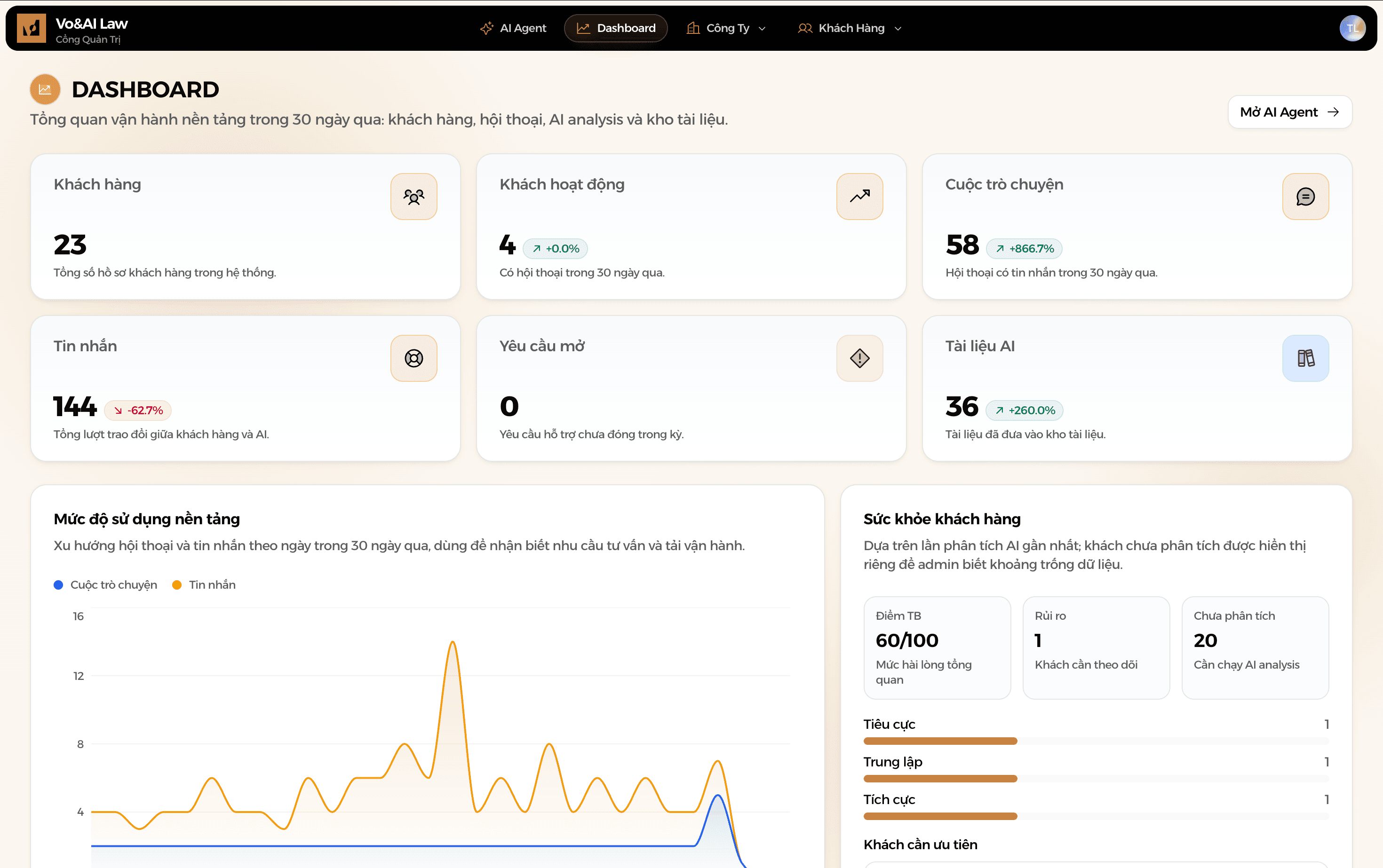
Vo & Associates needed one daily command center for the firm. Without it, lawyers and paralegals had to move between cases, documents, tasks, support requests, AI sessions, and finance views just to understand the day.
Lucents designed the dashboard around operational awareness. The team can see active cases, open tasks, recent AI work, pending support requests, and revenue signals in one place.
Lucents built the Admin Dashboard to help the firm start each day with clarity and move quickly into the work that needs attention.
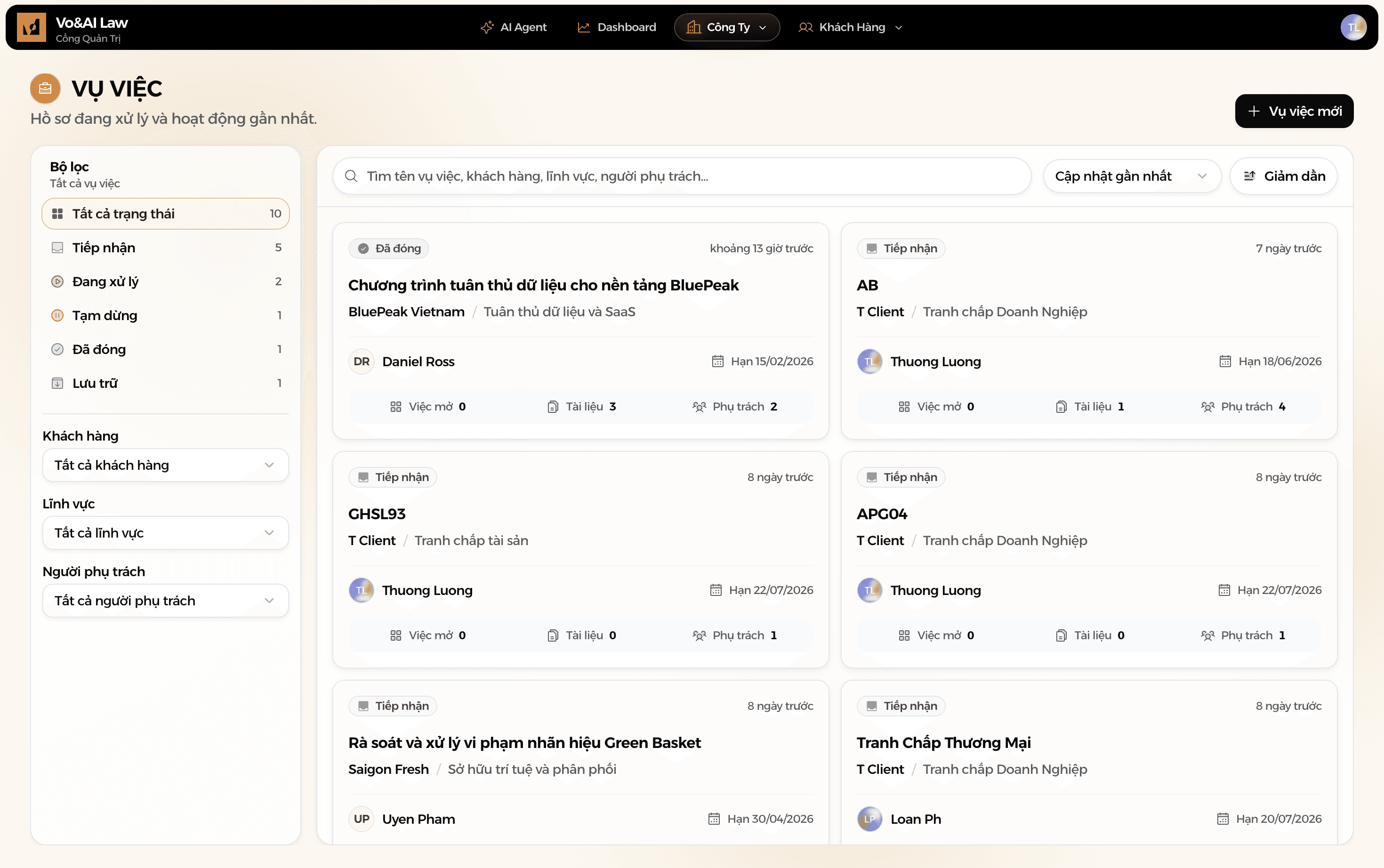
Case workspace
Legal work breaks down when a matter is treated as a loose collection of files and messages. Vo & Associates needed every engagement to have one structured home, with the right client, team, documents, tasks, timeline, status, visibility, and revenue context attached to it.
Lucents made the case the core unit of the platform. Each matter became a living workspace where the firm can manage the work, separate internal and client-visible information, and keep ownership clear.
Lucents built the Case Workspace so every legal engagement has a reliable operating surface.
Vault
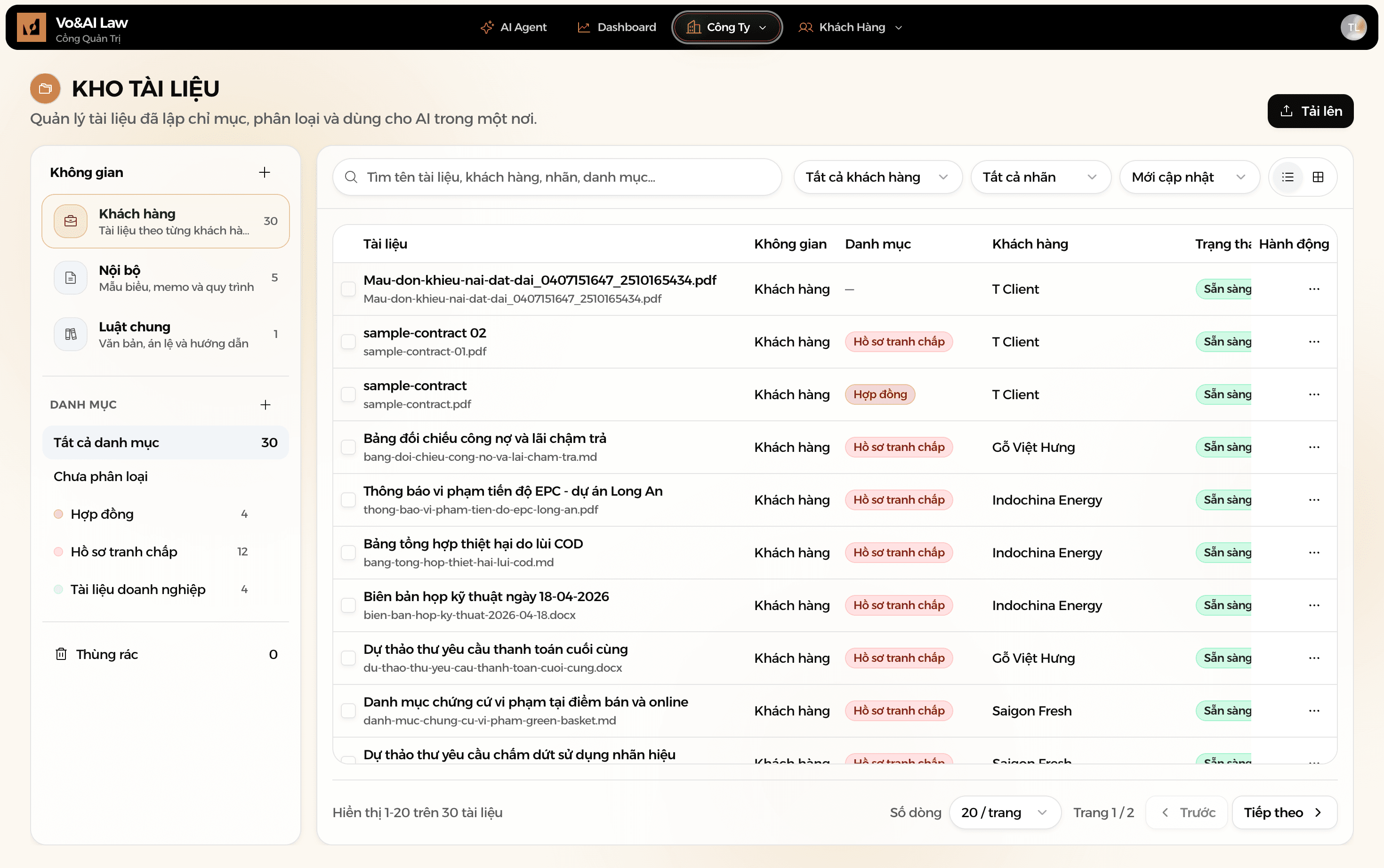
Documents were the foundation of the product. They were also the biggest risk. If files are scattered, outdated, wrongly shared, or not connected to a case, the firm loses time and AI loses context.
Lucents designed the Vault as a shared document library across the firm. Files can be tagged as general law, internal material, or case documents. Each file carries ownership, case context, client context, upload history, ingestion status, and sharing controls.
Lucents built the Vault so Vo & Associates could turn documents into structured legal memory instead of scattered storage.
Internal AI Agent
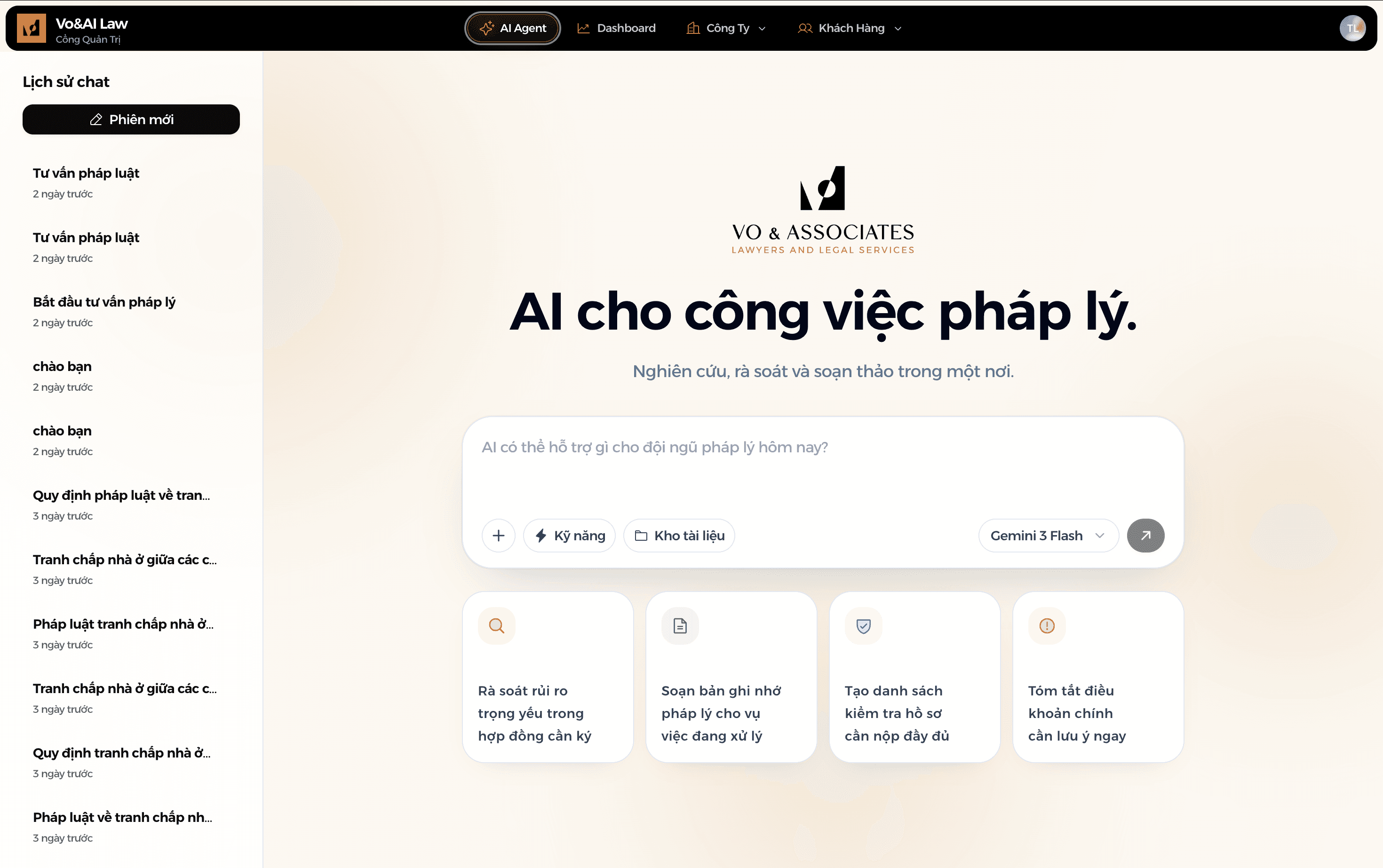
Vo & Associates wanted AI to help with drafting, review, research, and case analysis. But in legal work, uncontrolled AI creates risk. A lawyer needs to know which documents the AI used, which case it is working on, and whether the output is still a draft.
Lucents placed AI inside the firm's workflow. Lawyers can choose work modes, attach local files, pull from the Vault, generate DOCX artifacts, and keep AI outputs under lawyer review before they reach a client.
Lucents built the Internal AI Agent so the firm could speed up legal work while keeping human judgment in control.
Vo & Associates transformation
The shift
Before Lucents
Vo & Associates faced daily operational headaches. Case context lived across documents, messages, tasks, client questions, and memory. The firm had to spend energy chasing information before doing the legal work.
Lucents forward deployment
Lucents came in close to the work. We listened, mapped the pain, designed the operating model, shaped the roadmap, chose the technology direction, built the product, absorbed feedback, and iterated with the Vo & Associates team until the system matched the firm's reality.
After Vo&AI Law
Vo & Associates now has a platform to manage cases, documents, clients, finance, support, and AI in one place. The firm can respond faster, keep work clearer, and scale operations with a system built around how the team already works.
Before Vo&AI Law, the firm carried the burden of coordination manually.
After Vo&AI Law, the platform carries more of that burden.
Lawyers still make the legal judgment. The system now gives them cleaner context, better visibility, faster drafting support, safer client access, and a stronger base for growth.
Build AI on top of the work, not beside it.
Lucents helps service firms turn scattered operations into software their team can actually use. We start with the workflow. We place engineers close to the users. We build the roadmap with the client. Then we turn AI into a practical system that saves time, protects context, and keeps humans in control.
Book a discovery call.